CRC Throughout the years
-
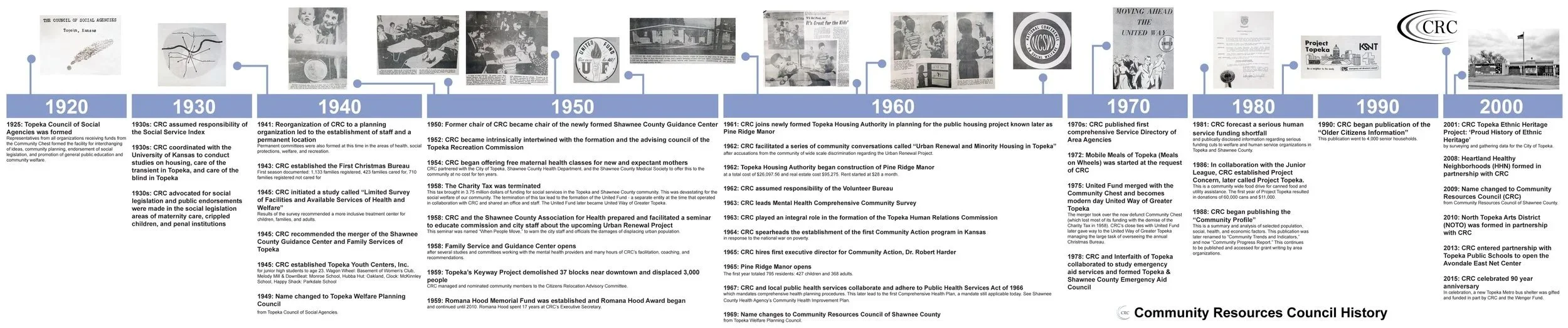
1925: Community Resources Council is formed as the Topeka Council of Social Agencies (TCSA), emerging from the Community Chest to focus on community planning, social services, and public welfare.
-
1930s: CRC assumes responsibility for the Social Service Index, now known as the Community Progress Report.
1930s: Partners with the University of Kansas to conduct studies on housing, care of the transient, and services for individuals who are blind.
1930s: Advocates for social legislation supporting maternity care, children with disabilities, and penal institutions.
-
1941: CRC reorganizes into a formal planning organization with staff, a permanent location, and standing committees.
1943: Establishes the first Christmas Bureau, serving hundreds of families despite limited resources.
1945: Conducts the Limited Survey of Facilities and Available Services of Health and Welfare.
1945: Recommends the merger of the Shawnee County Guidance Center and Family Services of Topeka.
1945: Establishes Topeka Youth Centers, Inc.
1949: Organization becomes known as the Topeka Welfare Planning Council.
-
1950: CRC leadership supports the formation of the Shawnee County Guidance Center.
1954: Begins offering free maternal health classes in partnership with city and county agencies.
1958: The Charity Tax is terminated, prompting the formation of the United Fund (later United Way of Greater Topeka).
1958: Facilitates the When People Move seminar to address impacts of urban renewal.
1958: Family Service and Guidance Center opens following CRC-led studies and planning.
1959: Establishes the Romana Hood Memorial Fund and award.
1959: Topeka Keyway Project displaces thousands; Pine Ridge Manor is later built.
-
1961: CRC collaborates with the Topeka Housing Authority in planning for Pine Ridge Manor.
1962: Facilitates community discussions on urban renewal and minority housing.
1962: Assumes responsibility for the Volunteer Bureau.
1963: Leads the Mental Health Comprehensive Community Survey.
1963: Plays a key role in forming the Topeka Human Relations Commission.
1964: Spearheads Kansas’s first Community Action Program.
1965: Hires the first executive director for Community Action.
1965: Pine Ridge Manor opens.
1967: Collaborates on comprehensive health planning under the Public Health Services Act.
1969: Name changes to Community Resources Council of Shawnee County.
-
1970s: Publishes the first Service Directory of Area Agencies.
1972: Research leads to the creation of Mobile Meals of Topeka, now Meals on Wheels.
1975: United Fund merges with the Community Chest, becoming United Way of Greater Topeka.
1978: Collaborates to form the Topeka & Shawnee County Emergency Aid Council.
-
1981: Forecasts and publicly reports major human service funding shortfalls.
1986: Launches Project Concern (later Project Topeka), a community-wide food and utility drive.
1988: Begins publishing the Community Profile, now the Community Progress Report.
-
1990: Launches Older Citizens Information, distributed to thousands of senior households.
1990s: Continues community data, planning, and collaboration efforts.
-
2001: Initiates the Topeka Ethnic Heritage Project.
2008: Helps form Heartland Healthy Neighborhoods and provides fiduciary management.
2009: Organization shortens name to Community Resources Council (CRC).
-
Coming Soon.
-
90 Years of CRC serving our community!
More Coming Soon!
-
2020s: Expands housing advocacy through CRC SAFE Homes, serving veterans, individuals with disabilities, and low- to moderate-income families.
2020s: Continues publishing trusted community data and strengthening partnerships.
2025: CRC celebrates 100 years as a catalyst for collaboration, advocacy, research, and education.